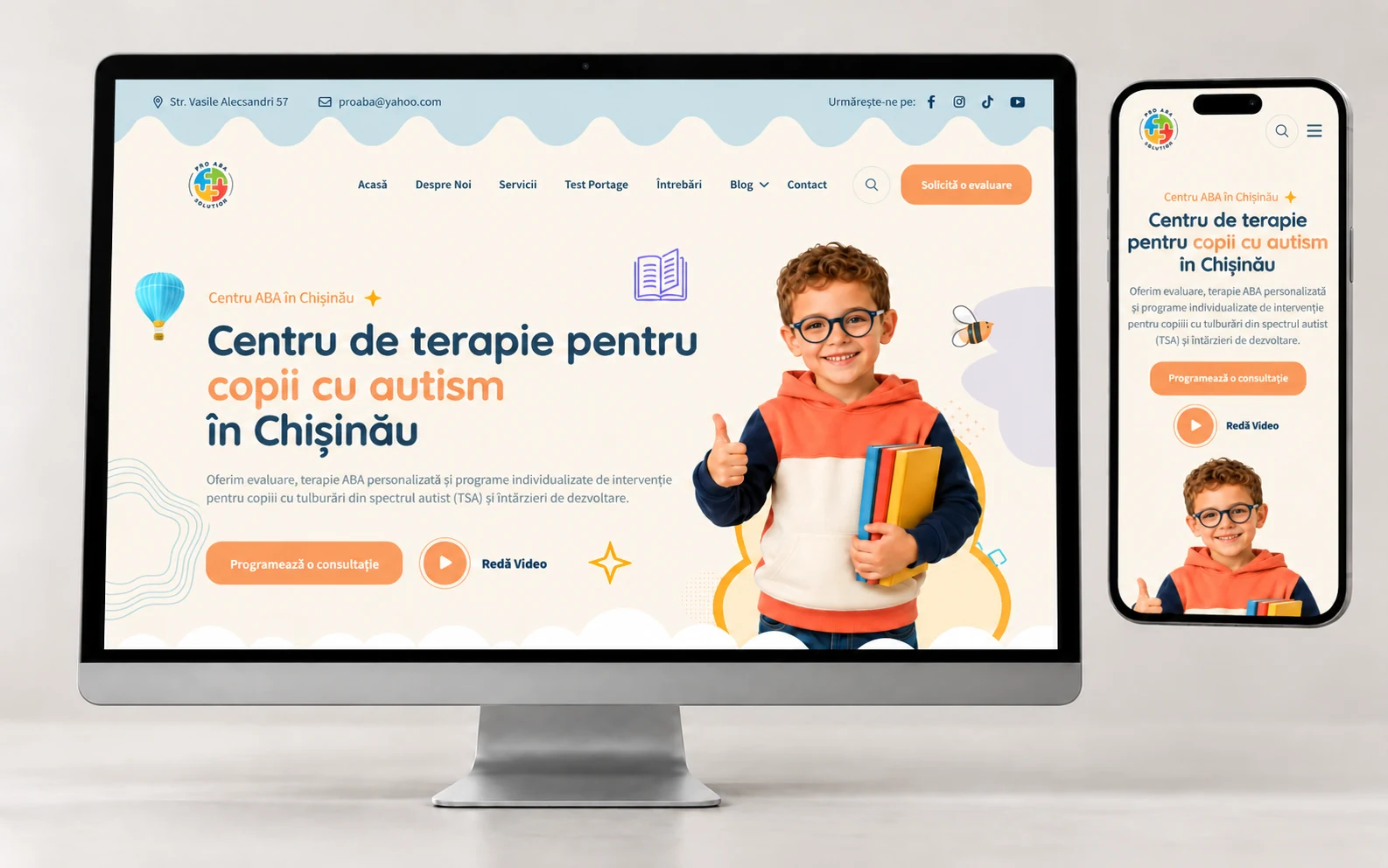
A website for information, contact and content management
For PRO ABA SOLUTION, we built a website that introduces the centre, its team and its services through a clear page structure. Visitors can find relevant information and contact options on both desktop and mobile.
The project includes the public website, a custom administration panel and an integrated Portage module. Content is organised into service pages, frequently asked questions and articles, with links between sections and a dedicated page for each service.
Responsive website for desktop and mobile
Custom management of services, team, FAQs and blog
Contact forms and Telegram notifications
Integrated Portage module and PDF reports
Metadata, readable URLs and structured data
Technology and architecture
The website is built with PHP and an HTML, CSS and JavaScript interface. Bootstrap provides components and responsive layout, while jQuery and Swiper support interactions and carousels.
Content and application data are stored in SQLite and accessed through PDO. Services, team members, FAQs, articles and contact messages are managed from the same panel. This structure allows information to be updated without manually editing each page.
Implemented features
We organised the centre overview, service pages, team, FAQs and blog, together with site search. Navigation, forms, carousels and tables adapt to different screen sizes.
Contact forms save enquiries in the database for review in the administration panel and include a Telegram notification integration. Input validation, request limits and CSRF protection are handled on the server. External content has cookie preference controls and optional media loading.
Integrated Portage module and PDF reports
The Portage module is integrated into the website, with questions organised by domain and age group. The interface tracks completion progress, while responses and final results are processed and saved on the server.
Results can be retrieved using a private code. A reassessment compares the current result with the previous evaluation. The module includes result views, charts and PDF report generation, with saved assessments accessible in administration.
SEO implementation
We prepared page structure and readable URLs, page titles and meta descriptions, canonical addresses and Open Graph information for shared links. Service and article pages use structured JSON-LD data suited to their content, including navigation information where applicable.
The sitemap contains public pages and published content, while robots.txt defines crawler access rules. Articles have their own metadata fields, allowing SEO information to be maintained in administration.
